

How to Complete the FCC/ISED Product Questionnaire Without Delaying Certification
Regulatory compliance does not fail only because products are poorly designed or incorrectly tested. In many cases, failure occurs because organizations are reacting to the certification process as a formality instead of a technical requirement. Nowhere is this more evident than in the product questionnaire.
For accredited regulatory compliance test labs, the product questionnaire is the foundation used to understand technical details and device operation. Yet, treating this document as administrative overhead frequently leads to testing delays, rework, and certification setbacks.
This article establishes why the product questionnaire is a core technical deliverable and how to complete it correctly the first time.
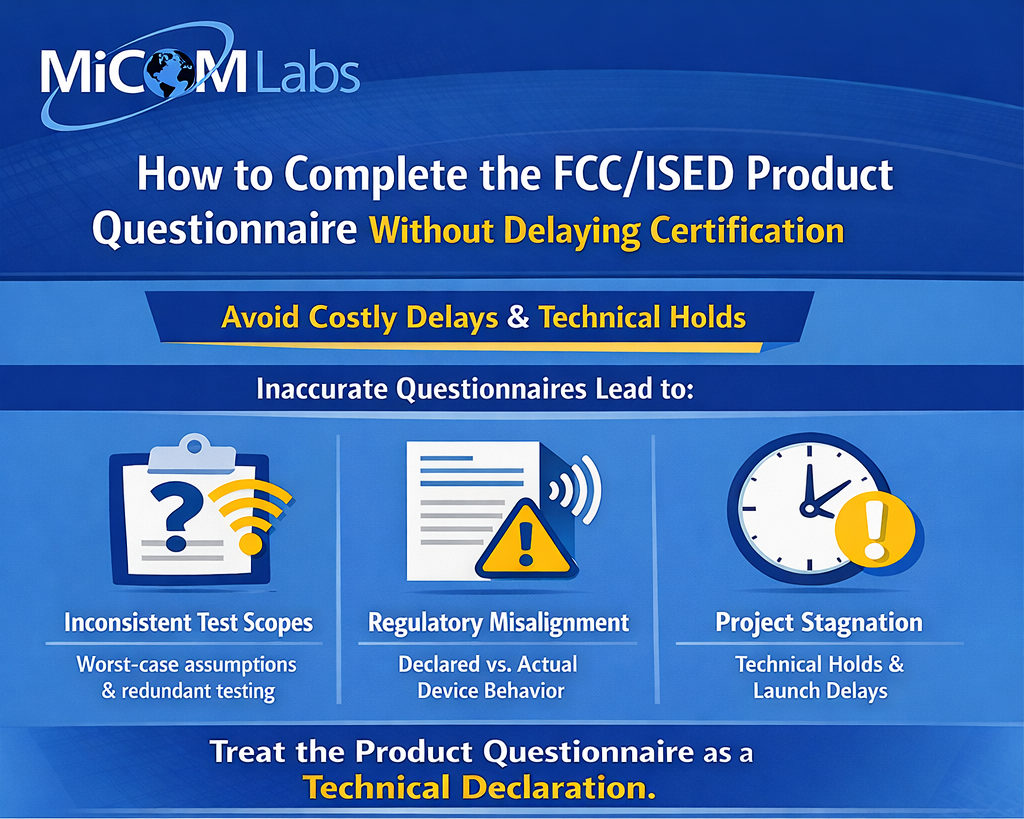
Why the Product Questionnaire Matters More Than Most Teams Realize
The product questionnaire is the first compliance filter. Before any test data is reviewed, certification bodies rely on the questionnaire to:
- Understand device architecture and industry application
- Identify applicable rules and standards (e.g., FCC Part 15 or ISED RSS).
- Assess test scope and configurations to ensure “worst-case” scenarios are captured.
- Flag inconsistencies between declared modes and hardware capabilities.
If the questionnaire is unclear or incomplete, confidence in the entire submission erodes, even if test results look acceptable. This dynamic is a common failure pattern that directly contributes to the certification delays discussed in our guide on Wireless Regulatory Compliance: Real-World Risks & Gray Areas.
Where Manufacturers Commonly Go Wrong
Treating the Questionnaire as Administrative Paperwork
Many teams assume the questionnaire is simply a data collection exercise. In reality, it is a technical declaration that must align with:
- Test reports and data plots.
- Schematics and block diagrams.
- Firmware behavior and versioning.
- Declared operating modes.
Misalignment triggers follow-up questions and sometimes expensive re-testing.
Starting testing without full product context is a high-risk strategy. Without detailed technical input, critical nuances regarding firmware or RF design are missed,gaps that only surface later during review.
How Questionnaires Drive Testing Scope and Outcomes
Certification bodies use the questionnaire to determine which standards apply and which test configurations are required. An incomplete questionnaire can:
- Expand test scope unnecessarily.
- Trigger requests for additional testing mid-project.
- Delay scheduling and final approvals.
Why Delayed Testing is a Growing Competitive Risk
In the current environment of reshoring and evolving regulations, supply chain shifts and lab capacity constraints have increased pressure on test schedules. In this landscape, poor preparation costs more, and first-pass success becomes critical. Incomplete questionnaires are no longer a minor inconvenience; they are a competitive disadvantage.
Best Practices for Completing the FCC/ISED Product Questionnaire
Manufacturers that avoid delays treat the questionnaire as part of compliance engineering, not paperwork. Best practices include:
- Completing the questionnaire only after the design is complete.
- Ensuring questionnaire responses align with real world configurations.
- Involving radio, software, hardware engineering teams in the questionnaire process
- Documenting worst-case operating modes explicitly.
Conclusion
Wireless certification delays are often blamed on testing, but in practice, many are self-inflicted by incomplete product questionnaires. Manufacturers that treat this as a technical deliverable reduce risk, shorten timelines, and improve first-pass certification success.
Further Viewing/Reading Material from MiCOM Labs
[Technical Video] Completing the Online Product Questionnaire Explains the mechanics of the MiCMS® questionnaire and how to avoid common pitfalls that trigger technical holds.
Essential Documents for FCC Certification: A Complete Guide A breakdown of the supporting files required to validate the technical claims made in your questionnaire.
[Technical Video] Are You Test-Ready? The Wireless Compliance Readiness Checklist Highlights why proactive preparation reduces risk, delays, and redesign during the certification phase.
Regulatory Intelligence and Standards Monitoring Why staying ahead of regulatory change is a core requirement for modern product development.
Reshoring, Regulation, and the New Certification Risk Outlines the shifting global landscape and why documentation accuracy is more critical today than ever before.
Ready to streamline your next certification project with accurate technical data?