

For years, global compliance strategies were optimized for cost and speed. Testing followed manufacturing and manufacturing followed economics.
That model is no longer sustainable.
Having worked as a compliance engineer and now as the founder of a test lab, I have seen regulatory requirements change over the years. What distinguishes the current movement is the realization that data integrity, its accuracy, completeness, and the reliability of information is now the primary metric for certification success.
The shift toward reshoring is not merely a geopolitical preference, it is a direct response to the systemic breakdown of data integrity within global compliance infrastructures.
For many manufacturers, the challenge today is not technical non-compliance – it is where, how, and by whom compliance data is generated.
The Erosion of Trust in Foreign Data
Regulatory scrutiny from the FCC and ISED is increasing because the “data source” has become a critical vulnerability. Recent actions have highlighted that when data is generated in regions with obscure oversight, the integrity of that data cannot be guaranteed.
Heightened Scrutiny: The FCC’s May 2025 “Bad Labs” Report and Order specifically targeted labs where ownership or external control creates a risk of data manipulation.
Further the FCC’s December 2025 announcement regarding UAS (Uncrewed Aircraft Systems) enhances US regulatory scrutiny.
Data Rejection: Regulators are no longer just looking for technical failures, they are investigating whether data is attributable, legible, contemporaneous, original, and accurate (ALCOA). Reports originating from certain regions now face elevated acceptance risk because their underlying data integrity is considered indefensible.
This is not a blanket rejection of overseas labs, but a material shift in how data is evaluated. For manufacturers, this means that where testing is performed now directly affects certification risk and timelines.
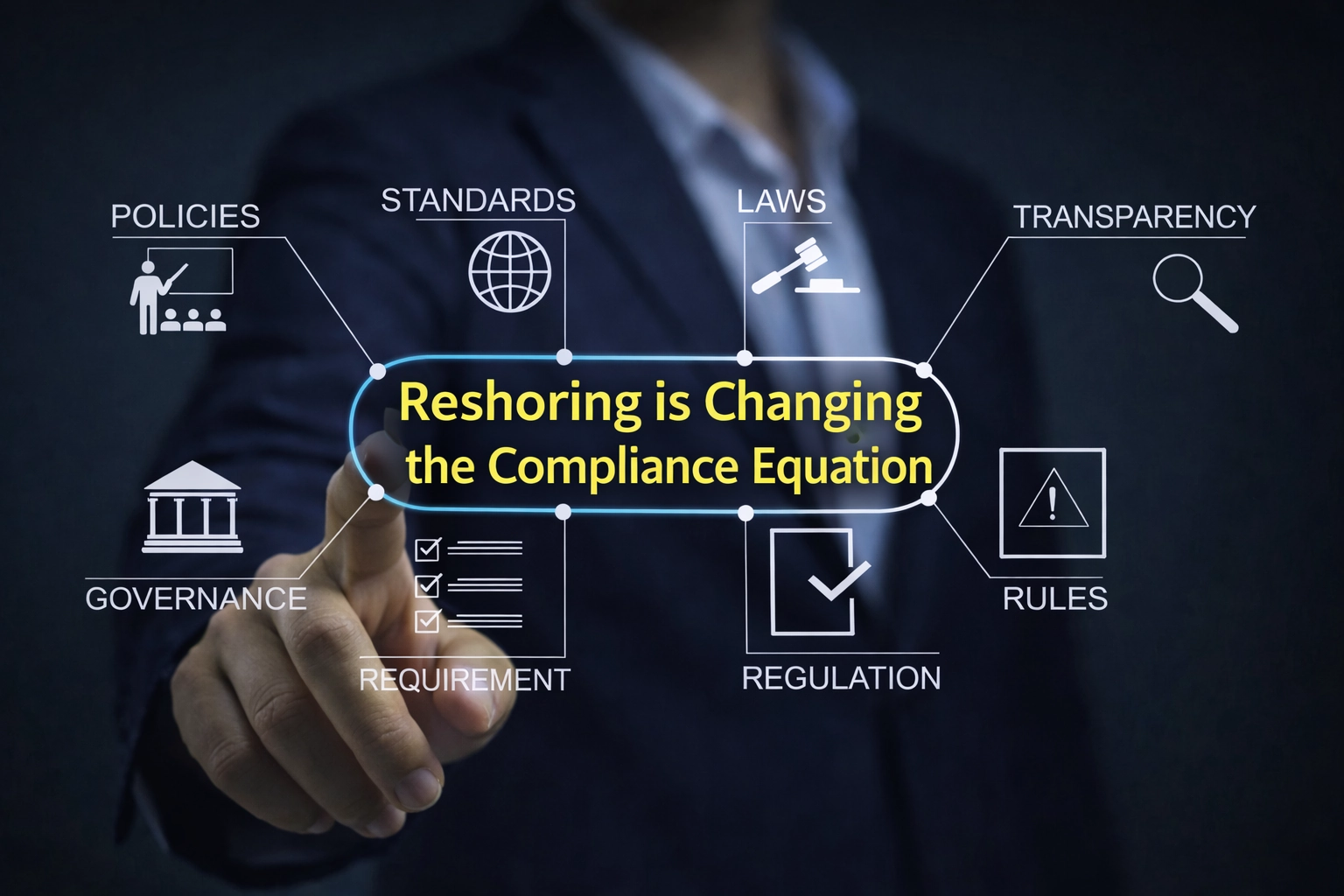
Reshoring as a Risk Management Strategy
For manufacturers, reshoring is the most effective way to restore the “chain of trust” required for product authorization.
Defensible Data: By moving testing to North America and allied regions, manufacturers ensure that compliance data is produced under transparent, traceable, and enforceable standards.
Capacity Strains: As manufacturers flee high-risk regions to protect their data integrity, trusted domestic labs are operating at capacity. This makes the decision to reshore not just an engineering task, but a critical supply-chain and enterprise risk-management decision.
Relationships: Future relationships with trusted labs are no longer optional, they are a strategic asset.
Manufacturer Checklist: Certification Readiness in a Reshoring Environment
- Assess certification capacity risk now
Do not assume test lab availability will match historical timelines – North American capacity is constrained and delays are becoming structural. - Identify dependency on offshore or China-based test labs
If any FCC, ISED, or regional certifications rely on Chinese labs, treat this as an active risk – not a contingency. - Revalidate regulatory pathways for all target markets
Legacy approval strategies may no longer be viable under evolving FCC and ISED scrutiny. - Engage compliance labs early before final design freeze
Late-stage lab engagement now increases cost, redesign risk, and time-to-market failure. - Secure priority access with trusted, accredited labs
Transactional relationships are no longer sufficient; capacity favors long-term partners. - Model tariff and reshoring cost impact on certification strategy
Certification delays and rework now materially affect landed cost and revenue timing. - Stress-test launch timelines against worst-case approval scenarios
Best-case assumptions are no longer realistic in a reshoring-driven environment. - Assign executive ownership of certification risk
Certification is no longer a downstream engineering task, it is a strategic risk function.
How MiCOM Labs Mitigates Data Integrity Risk
At MiCOM Labs, we treat data integrity as a strategic risk function rather than a downstream task.
Mandatory Compliance Questionnaires: We embed structured questionnaires into every test report to define regulatory intent and RF behavior explicitly, ensuring every data point is traceable and defensible.
Eliminating Inference: Regulators expect clarity, not assumptions. Our approach ensures that all metadata-timestamps, user IDs, and configurations are visible and unalterable, meeting the highest standards of integrity.
Good data is no longer enough. Data integrity now determines its acceptance.
The New Reality Manufacturers Must Accept
Reshoring has not simplified compliance; it has raised the bar for what constitutes “good data”. Compliance strategy is no longer just about meeting technical limits – it is about ensuring the integrity of the data that proves those limits were met.
A compliance strategy is no longer just an engineering concern, it is a supply-chain and risk-management decision.
A Final Thought
In today’s reshaped global landscape, data reliability is the difference between seamless certification and regulatory vulnerability. Manufacturers that strengthen data integrity through reshoring gain control and predictability, while those that fail to adapt invite delays and scrutiny.
The rules have changed, certification strategies must change with them.