

For many manufacturers, global expansion begins with sales forecasts, distribution plans, and market demand analysis. Regulatory compliance is often treated as a secondary checkpoint, something to “handle when we get there.”
In reality, Global Market Access (GMA) often determines whether international expansion moves forward smoothly or stalls in cycles of re-testing, documentation gaps, and unexpected country-specific requirements.
The companies that scale successfully across regions do not treat certification as a series of isolated approvals. They treat global regulatory compliance as a structured, lifecycle discipline.
This article outlines how to approach international market access strategically, and why regulatory readiness frequently becomes the true limiting factor in global growth.
Why Global Market Access Is More Than Certification
A product that passes certification in one country is not automatically ready for the world.
International expansion exposes assumptions that remain invisible during single-market launches. Even where standards appear harmonized, differences below can create unexpected barriers:
- Emission limits
- Testing methodologies
- Documentation requirements
- Labeling rules
- Regulatory interpretation
Global Market Access typically breaks down when:
- Products are designed narrowly for one initial region
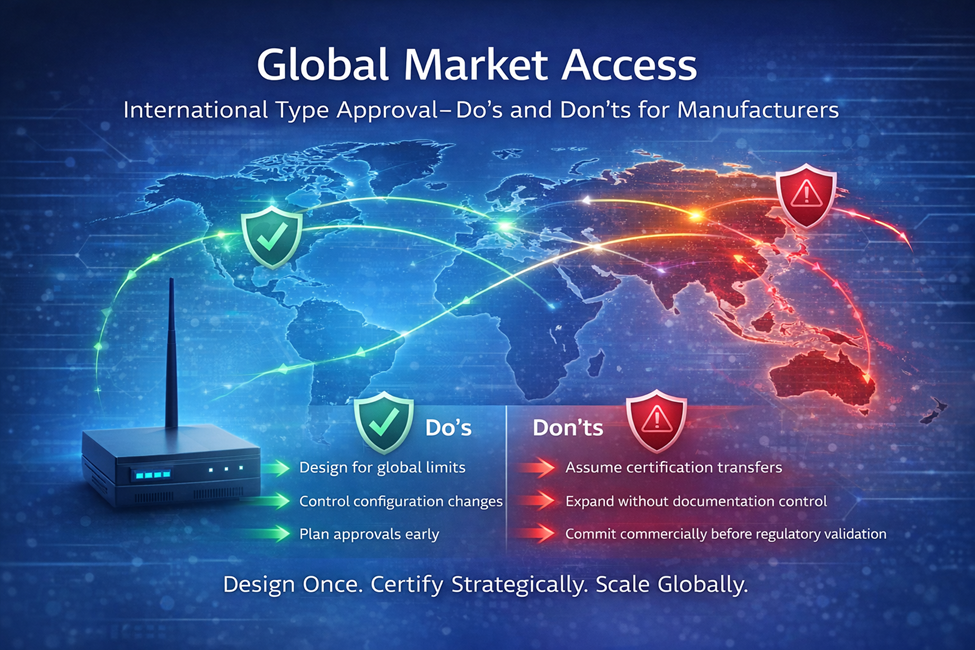
- Teams assume certification is transferable without validation
- Documentation and configuration control lack discipline
- Regulatory planning begins after commercial launch commitments
These failures rarely stem from technical incompetence. They stem from the absence of a defined global compliance strategy.
When regulatory planning trails commercial ambition, certification becomes reactive, and expensive.
International Type Approval Is Market-Specific by Design
One of the most persistent misconceptions in global expansion is that international approvals are extensions of one another. They are not.
International Type Approval is inherently market-specific, even when standards share technical foundations.
Entering a new country often requires:
- Supplemental or modified testing
- Market-specific report formatting
- Local representation or certification body engagement
- Unique labeling, import, or registration processes
Assuming equivalence without verification is one of the most common causes of delayed product launches.
Regulators evaluate compliance within their own frameworks. Harmonization reduces duplication, but it does not eliminate regional interpretation.
Companies that recognize this early design their compliance programs accordingly. Those that do not frequently discover that “already certified” does not mean “ready for approval.”
Global Expansion Exposes Lifecycle Weaknesses
Global Market Access does not create compliance problems. It magnifies the ones that already exist.
Products that encounter repeated international delays often share predictable traits:
- Minimal compliance margin at original certification
- Weak hardware or firmware change control
- Fragmented or outdated regulatory documentation
- Poor traceability between product variants
As additional markets are added, these weaknesses compound. What was manageable in one region becomes unmanageable across five or ten.
The problem becomes especially visible during manufacturing transitions, component substitutions, or supply chain shifts. Changes that appear minor internally may invalidate certifications externally.
Global expansion rewards disciplined lifecycle management, and punishes improvisation.
Designing for Global Compliance from Day One
The most successful international launches begin before the first overseas filing.
Lifecycle-aware engineering teams incorporate global considerations during initial product design, even if the first launch targets a single country.
Designing with global expansion in mind often includes:
- Designing to the most stringent practical regulatory limits
- Preserving compliance margin beyond minimum pass thresholds
- Avoiding unnecessary region-specific hardware variations
- Anticipating documentation reuse across jurisdictions
This proactive approach dramatically reduces the likelihood that entering a new market will require redesign, additional testing cycles, or complete re-certification.
Global scalability is rarely achieved through retroactive fixes. It is built into the architecture.
Documentation: The Hidden Engine of International Approvals
As geographic coverage expands, documentation quality becomes as critical as laboratory results.
Regulators and certification bodies rely heavily on clear, consistent technical files. Even strong test data can be delayed by unclear reports, mismatched declarations, or poorly controlled revisions.
Common documentation failures include:
- Test reports referencing obsolete configurations
- Inconsistent Declarations of Conformity across regions
- Unclear relationships between hardware variants
- Missing traceability between firmware versions and certifications
Disciplined documentation practices allow approvals to move forward with fewer regulatory questions and fewer resubmissions.
In global market access, documentation is not administrative overhead, it is operational infrastructure.
Global Market Access Is an Ongoing Process — Not a Milestone
Approvals are not static achievements.
Standards evolve. Regulatory interpretations shift. Products change. Supply chains adapt.
Organizations that manage Global Market Access effectively:
- Track approvals by country, product variant, and revision level
- Assess regulatory impact before engineering changes are released
- Align expansion plans with certification timelines
- Monitor regulatory updates across active markets
This structured approach transforms global expansion from a reactive scramble into a controlled, predictable process.
Conclusion: Regulatory Readiness Determines Global Velocity
Global Market Access is not a paperwork exercise. It is a strategic capability.
Manufacturers that treat International Type Approval as a lifecycle discipline reduce delays, control certification costs, and maintain momentum as they expand internationally.
Those that do not often discover that regulatory readiness — not market demand — becomes the real constraint on growth.
In global expansion, certification is not the final step.
It is the gatekeeper.
Ready to Begin the Testing Process?
A proactive strategy is only half the battle. For a technical, stage-by-stage breakdown of the six critical phases of formal certification, explore our comprehensive guide: Regulatory Compliance & Certification: The Manufacturer’s Guide to Global Market Access.