

Most wireless product failures are decided before the first compliance test is ever scheduled.
Regulatory breakdown rarely originates in the test lab. It is introduced earlier, in RF architecture decisions, antenna placement, firmware behavior, clocking strategy, and unmanaged product revisions. By the time a device reaches formal certification, the outcome is often structurally determined.
Companies that experience repeated RF failures or delayed certifications are not ignoring regulations. More often, they are treating compliance as a milestone rather than a lifecycle discipline.
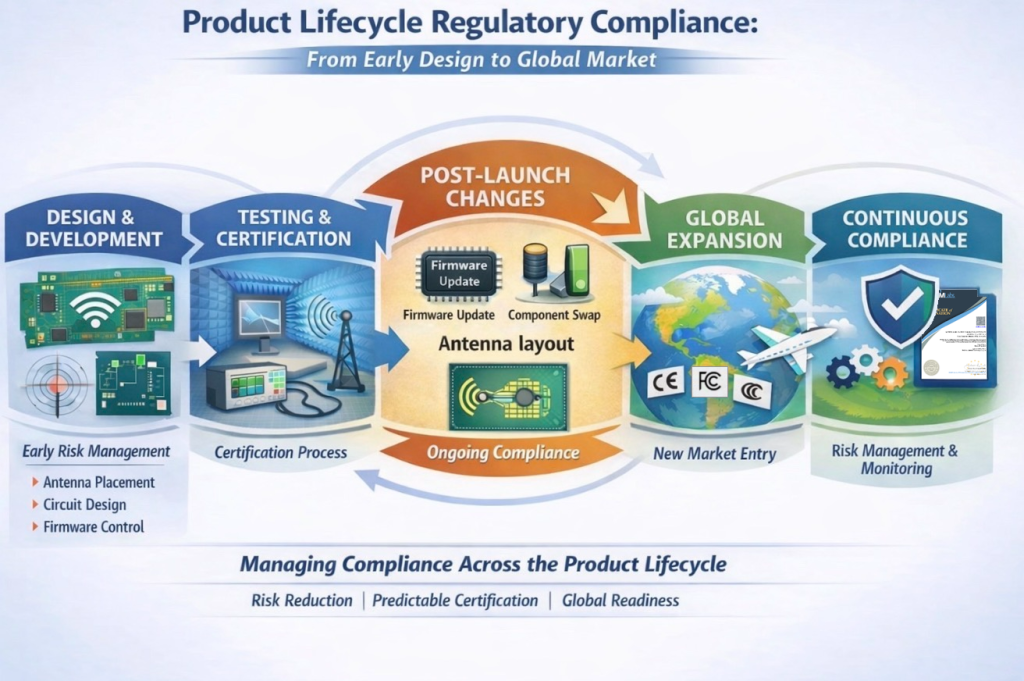
A product lifecycle approach to regulatory compliance reframes certification as continuous risk control, beginning at design and extending through validation, change management, and global market expansion.
Why Regulatory Compliance Breaks After Certification
Certification confirms that a specific configuration met regulatory requirements at a specific moment in time. It does not guarantee that future versions remain compliant.
In practice, compliance breaks in predictable ways. Firmware evolves and alters transmit duty cycles. Components are substituted under supply-chain pressure. Antennas or enclosures are revised for mechanical or industrial design reasons. Products expand into new regions without reassessing regulatory assumptions.
Each change may appear minor in isolation. Collectively, they can trigger partial retesting, new filings, or in some cases a full certification reset — often late in the launch cycle.
Certification is a snapshot. Products are dynamic systems.
Without lifecycle controls, that gap becomes expensive.
Compliance Starts at Design — Not at the Test Lab
The most consequential compliance decisions are made long before a product is scheduled for testing.
Antenna placement determines radiation patterns and coupling behavior. Grounding and power-distribution strategy influence emissions performance. Clock architecture affects harmonic structure. Firmware defines transmit timing, channel occupancy, and operational states.
When these decisions are made without regulatory context, testing becomes a discovery exercise rather than a validation step.
A lifecycle regulatory strategy integrates compliance considerations into design reviews. It forces early evaluation of worst-case operating modes, RF exposure assumptions, and foreseeable product changes.
If compliance is first discussed when test samples are being prepared, risk has already accumulated.
Pre-Compliance and Test Readiness Reduce Disruption
Pre-compliance testing is not about passing early, it is about validating assumptions while engineering still has flexibility.
Effective pre-compliance focuses on:
- Worst-case operating modes, not typical use
- Realistic firmware behavior and feature combinations
- Representative hardware and antenna configurations
Teams that skip structured pre-compliance rarely move faster. They shift risk downstream, where corrections require redesign instead of refinement.
Well-managed test readiness shortens certification timelines not because problems disappear, but because they surface early, when they are still manageable.
Certification Is a Milestone, Not an End State
Passing certification does not freeze a product in time. Post-launch changes are inevitable.
Post-certification risk commonly comes from:
- Firmware updates that alter RF behavior
- Component substitutions affecting RF paths
- Mechanical changes that alter antenna environment
Regulatory frameworks allow controlled change, but only when manufacturers understand how to evaluate impact and maintain documentation continuity.
Lifecycle compliance requires structured change management: defined review triggers, engineering evaluation of RF impact, and disciplined recordkeeping across revisions.
Without it, incremental changes accumulate into compliance instability.
Lifecycle Compliance Enables Global Expansion
Global market access exposes weak lifecycle discipline.
Products designed narrowly for a single regulatory environment often struggle when introduced into new regions with different power limits, spectrum allocations, labeling rules, or documentation requirements.
Lifecycle-aware teams design with foreseeable expansion in mind. They maintain reusable test data, preserve traceable documentation, and align hardware variants under controlled change processes.
This does not eliminate regulatory complexity. It makes it manageable.
Global expansion succeeds when compliance strategy is integrated into product architecture, not retrofitted after domestic launch.
The Commercial Cost of Ignoring the Lifecycle
Poor lifecycle compliance rarely appears as a single dramatic failure. Instead, cost accumulates quietly:
- Repeated RF and EMC testing cycles
- Certification delays that push back launch windows
- Engineering rework that diverts senior technical resources
- Delayed revenue recognition or blocked market entry
The most expensive compliance failures are not failed tests, they are late-stage redesign decisions made under time pressure.
When compliance is treated as a lifecycle discipline, risk is identified at design, validated before certification, and controlled through structured change management.
The result is not simply successful testing. It is predictability.
Conclusion
Product lifecycle regulatory compliance is not about passing a test. It is about controlling regulatory risk from architecture decisions through global commercialization.
Organizations that embed compliance into design reviews, pre-compliance validation, and post-certification change processes experience fewer surprises and shorter certification timelines. Certification becomes predictable because risk is addressed early, continuously, and deliberately.
In complex wireless environments, lifecycle discipline is not optional it is the difference between reactive testing and controlled product evolution.
Further Reading (LINKS)
From Engineer to Founder: Why Compliance Fails – and How to Fix It
Why compliance failures are often organizational, not technical — and how leadership decisions shape certification outcomes.
https://micomlabs.com/from-engineer-to-founder-why-compliance-fails-and-how-to-fix-it/
RF Compliance Testing: Complete Guide
A technical overview of RF testing requirements, evaluation methods, and common failure drivers.
https://micomlabs.com/rf-compliance-testing-complete-guide/
Wireless Device Testing Requirements – The Complete RF Sample Preparation Checklist
A practical checklist for preparing hardware and firmware before entering formal certification.
https://micomlabs.com/wireless-device-testing-requirements-the-complete-rf-sample-preparation-checklist/
Regulatory Compliance Requirements Breakdown
Explains how regulatory obligations vary across regions, product types, and revisions.
https://micomlabs.com/regulatory-compliance-requirements-breakdown/
Global Market Access: A Practical Guide to Expanding into International Markets
A structured framework for managing certification and approvals across multiple countries.
https://micomlabs.com/global-market-access-guide/