

For many manufacturers developing wireless products, integrating a pre-certified radio module appears to offer a predictable path to regulatory approval. Modules carrying an FCC ID or ISED certification number are often marketed as “drop-in compliant,” leading teams to assume that certification risk has largely been eliminated.
In reality, modular approval reduces regulatory scope but does not remove responsibility from the host product manufacturer. Both the Federal Communications Commission (FCC) and Innovation, Science and Economic Development Canada (ISED) place clear obligations on integrators to ensure that final products continue to meet applicable requirements after installation of the module.
Many certification delays occur not because the module fails, but because integration conditions change the compliance characteristics of the final device.
Understanding how modular approvals actually function within FCC and ISED frameworks is essential to avoiding unexpected testing requirements or authorization issues.
FCC Modular Approval Scope and Integration Obligations
FCC modular approvals are primarily defined under 47 CFR §15.212, supported by detailed interpretation guidance in FCC Knowledge Database (KDB) publications, particularly KDB 996369.
The purpose of modular approval is to demonstrate that a transmitter can operate independently of a specific host platform. To achieve this, the FCC requires that the module meet conditions related to shielding, buffered inputs, power regulation, antenna compliance, standalone testing configuration, labeling, rule compliance, and RF exposure evaluation.
However, the regulatory intent is frequently misunderstood. Modular approval does not certify the host device. It certifies the transmitter under defined conditions.
Once the module is integrated into a new host, the manufacturer assumes responsibility for confirming that those conditions remain valid. Changes in grounding, enclosure materials, antenna type/gain, or proximity to users can all alter emissions behavior or RF exposure characteristics. When those factors change, additional evaluation is often necessary even if the transmitter itself remains unchanged.
FCC integration guidance also emphasizes that the host product must still comply with all other applicable requirements, particularly those governing unintentional radiators under Part 15 Subpart B. A digital host device containing a certified module still requires its own emissions assessment and authorization pathway where applicable.
ISED Modular Approval Framework and References
ISED follows a modular approval concept similar to the FCC, but it is governed through Canadian standards documents rather than U.S. regulations. The primary references include:
- RSS-Gen — General Requirements for Compliance of Radio Apparatus
- RSP-100 — Radio Equipment Certification Procedure
- Applicable Radio Standards Specifications (RSS) for the technology
- RSS-102 — RF Exposure Compliance
RSS-Gen explicitly addresses modular approvals and integration responsibilities, including requirements for labeling, user information, antenna restrictions, and compliance with exposure limits after installation into a host product.
Like the FCC, ISED distinguishes between full modular approval and limited modular approval conditions. Limited approvals may restrict the module to specific host environments or require additional evaluation during integration.
A critical difference that manufacturers sometimes overlook is that ISED places strong emphasis on ensuring that the final host configuration continues to meet exposure and emissions requirements defined in Canadian standards, even when the radio hardware itself has already been certified.
This means that FCC approval alone does not establish compliance for Canada, and identical hardware may still require additional evaluation or documentation under ISED rules.
RF Exposure and Co-Location Considerations
RF exposure compliance is one of the most common areas where integration assumptions break down. Modules are typically evaluated using specific antenna configurations and separation distances that may not reflect the final host product design.
When integration changes antenna location, user proximity, or operating conditions, the exposure classification of the device can change from mobile to portable, potentially triggering SAR evaluation requirements instead of MPE calculations.
The presence of multiple transmitters further complicates the analysis. Simultaneous transmission scenarios require assessment of aggregated exposure levels and potential interaction between radios. These evaluations are required under both FCC and ISED frameworks and frequently introduce unexpected testing scope late in development when they are not considered early.
Antenna Configuration and System-Level Emissions
Antenna substitution remains one of the highest-risk integration decisions. Module approvals typically specify permitted antenna types and maximum gain limits. Even when the antenna appears electrically similar, differences in placement, cable routing, or enclosure interaction can alter radiated emissions performance.
Host product mechanical design also plays a significant role. Plastic housings, metal frames, internal shields, and PCB grounding structures all influence RF behavior. Changes in these variables can create new spurious emissions or reduce margin relative to regulatory limits.
Because modules are tested in controlled standalone configurations, the final integrated system often behaves differently from the certified reference environment.
Labeling and Documentation Responsibilities
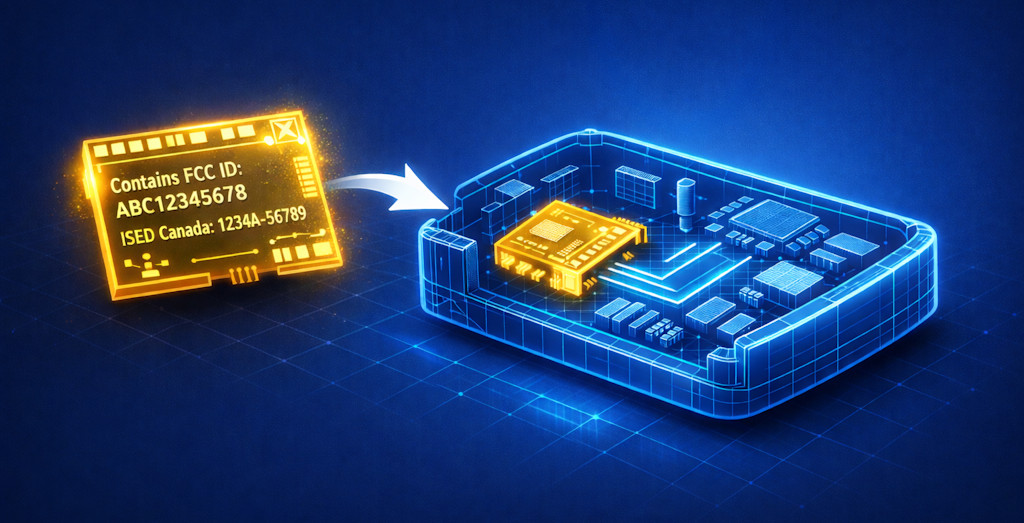
Regulatory labeling is another area where integration requirements are frequently misunderstood. Host products containing certified modules must include proper identification statements, such as “Contains FCC ID” and the corresponding ISED certification number, along with any required compliance notices.
However, labeling alone does not demonstrate compliance. Regulators evaluate whether integration followed the module’s approval conditions and whether the final device meets all applicable requirements. Missing user manual statements, incorrect labeling placement, or incomplete documentation can delay approvals even when testing is technically compliant.
ISED requirements also include bilingual labeling and user information obligations that differ from FCC expectations, which further reinforces the need for region-specific compliance planning.
Limited Modular Approval and Integration Constraints
Not all modules are approved under full modular conditions. Some receive limited modular approval because they rely on host characteristics for compliance, such as shared shielding, power regulation, or antenna configuration.
Limited approvals impose integration restrictions that must be carefully reviewed before product design begins. Integrating a limited-approval module into an unintended host environment can invalidate the certification and require a new authorization process.
Manufacturers sometimes discover these constraints late in development when certification bodies review documentation, resulting in schedule delays and additional engineering work.
Managing Compliance Risk During Development
Organizations that consistently achieve smooth approvals treat module integration as a system-level regulatory engineering activity rather than a simple hardware selection decision.
Early design reviews that consider antenna placement, grounding architecture, exposure classification, and multi-radio interactions significantly reduce uncertainty later in the certification process. Pre-compliance measurements of the integrated system can identify emissions risks before design changes become costly.
Regulatory planning should also consider both FCC and ISED requirements simultaneously, since differences in exposure rules, labeling obligations, and certification procedures can affect product configuration decisions.
Conclusion
Pre-certified wireless modules provide meaningful advantages, but they do not eliminate compliance responsibility for the final product. Both FCC and ISED frameworks require host manufacturers to verify that integration conditions remain consistent with the original approval and that the complete device meets all applicable regulatory requirements.
Manufacturers that recognize modular approval as one component of a broader compliance strategy, rather than a guarantee of authorization, are better positioned to avoid certification delays, redesign cycles, and market entry risks.
Ready to ensure your integrated system meets all host-level compliance requirements?