

EMC Risk Assessment: A Non-Negotiable Pillar of Medical Device Safety and Regulatory Approval
EMC risk assessment is a foundational element of medical device safety, performance, and regulatory success. As healthcare environments become increasingly saturated with wireless technologies and electrically complex systems, unmanaged EMI can compromise essential performance, patient safety, and clinical outcomes.
Regulators worldwide now expect a structured, evidence-based EMC risk management approach that is fully integrated throughout the device lifecycle.
Definitions
EU – European Union
EMC – Electromagnetic Compatibility
EMI – Electromagnetic Interference
FDA – U.S. Food and Drug Administration
MDR – Medical Device Regulation
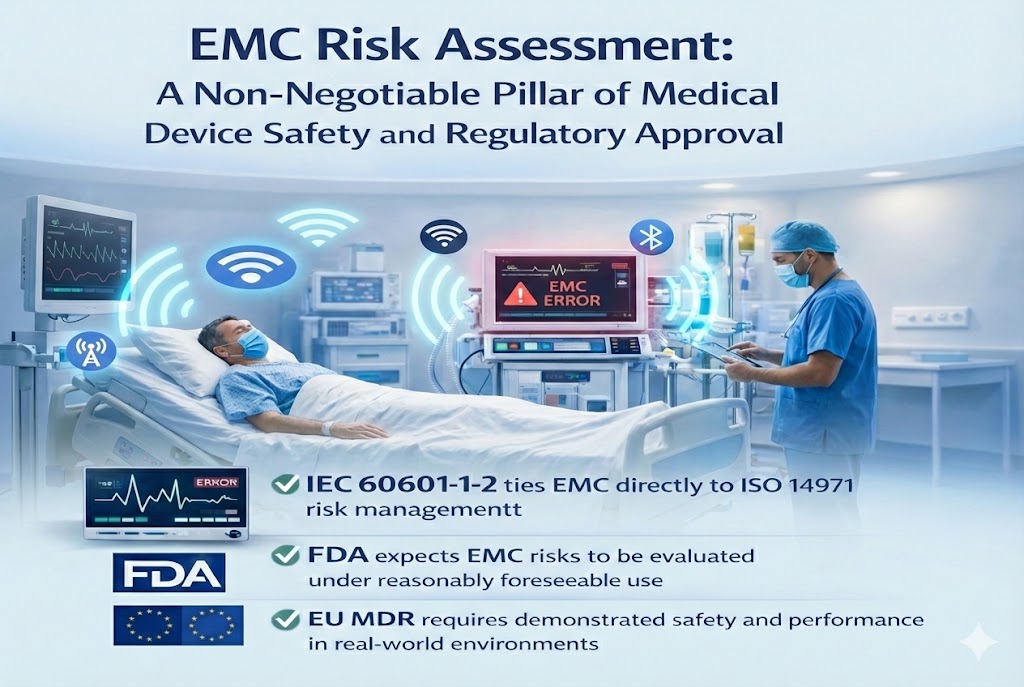
Why EMC Risk Assessment Matters
Medical devices must operate reliably in electrically noisy environments such as hospitals, clinics, and homes. These environments include Wi‑Fi networks, cellular signals, RFID systems, electrosurgical equipment, imaging systems, and other medical electronics operating simultaneously.
Without adequate EMC risk controls, electromagnetic disturbances can lead to:
- Degraded essential performance (e.g., inaccurate measurements or delayed alarms)
- Unintended operation or device resets
- Loss of therapy or monitoring functionality
- Potential patient or user harm
An effective EMC risk assessment identifies these hazards early and ensures appropriate mitigations are in place before the device reaches the market.
Regulatory Expectations Are Clear
Global regulatory frameworks explicitly link EMC to risk management:
| Regulatory Framework | Risk Management |
| IEC 60601-1-2 (Edition 4.1) | Requires EMC considerations to be addressed through the risk management process defined in ISO 14971. |
| FDA | Expects manufacturers to evaluate EMC risks under normal and reasonably foreseeable conditions of use. |
| EU MDR | Requires manufacturers to demonstrate safety and performance under both normal and fault conditions, including exposure to electromagnetic disturbances. |
Incomplete or poorly documented EMC risk assessments are a common cause of regulatory questions, test failures, and submission delays.
Core Elements of an Effective EMC Risk Assessment
| Core Element | Risk Assessment |
| Intended Use and Environment Analysis | Define where and how the device will be used, including professional healthcare settings versus home environments, proximity to RF transmitters, and the use of wireless technologies. |
| Identification of EMC Hazards | Systematically identify potential EMC-related hazards such as radiated and conducted RF immunity issues, electrostatic discharge (ESD), power quality disturbances, and equipment co-location risks. |
| Risk Evaluation | Assess the severity and probability of harm, with a focus on essential performance, basic safety, and clinical impact. |
| Risk Control Measures | Implement hardware, software, and system-level mitigations such as filtering, shielding, grounding, fault detection, alarms, labeling, and installation requirements. |
| Verification and Validation | Confirm the effectiveness of risk controls through EMC testing to IEC 60601-1-2, worst-case configuration testing, and wireless coexistence testing when applicable. |
Operational performance in noisy environments – proposed test matrix
| Type of Evaluation | Proposed Test | |
| 1.. | Elevated Immunity Levels (Beyond the Standard) | Test beyond IEC 60601-1-2 minimum levels for radiated and conducted immunity Justify higher levels based on: Potential hospital RF density Proximity to wireless transmittersLife-supporting or alarm-critical functions |
| 2.. | Multi-Source RF Exposure | Apply simultaneous or sequential RF sources rather than single-frequency exposure Reflect real-world scenarios where Wi-Fi, LTE, Bluetooth, and RFID coexist |
| 3.. | Functional Performance Testing During EMC Exposure | Verify essential performance and alarm functions while interference is applied Focus on: Alarm generationAlarm annunciationCommunication to nurse stations or gateways |
| 4.. | Cable and Accessory Worst-Case Configurations | Test with: Maximum cable lengthsThird-party accessoriesAll ports populated |
| 5.. | Wireless Coexistence & Performance Degradation Testing | Validate performance when: Band congestion is highPacket loss increases Assess latency, retries, and alarm delivery timing Extend exposure time beyond standard dwell timesIdentify intermittent or cumulative effects |
| 6.. | Alarm Priority & Degradation Behavior | Verify that: High-priority alarms cannot be maskedSystem fails safely (graceful degradation) |
| 7.. | Long-Duration Exposure Testing | Extend exposure time beyond standard dwell times Identify intermittent or cumulative effects |
EMC Risk Management Across the Product Lifecycle
EMC risk assessment should begin at concept development and continue throughout the product lifecycle:
| Concept & architecture: | Technology selection and system design |
| Development: | Design reviews and pre-compliance testing |
| Verification & validation: | Formal EMC testing and risk documentation |
| Post-market: | Complaint trending, field data review, and design change impact analysis |
This proactive approach reduces late-stage failures, minimizes redesign costs, and accelerates time to market.
The Cost of Getting It Wrong
Inadequate EMC risk assessment can result in failed EMC tests, regulatory submission rejections, delayed launches, or post-market corrective actions. In contrast, a strong EMC risk strategy improves device robustness, regulatory confidence, and patient safety.
Conclusion
EMC Risk Assessment:
– is a non-negotiable pillar of medical device safety and regulatory approval. Manufacturers that integrate EMC risk management early—and treat it as a strategic engineering discipline—are better positioned to deliver safe, compliant, and reliable medical technologies in today’s complex electromagnetic environment.
– is no longer optional. IEC 60601-1-2 explicitly links EMC to ISO 14971 risk management, and both FDA and EU MDR expectations require manufacturers to demonstrate safety and performance in the environments where devices are intended for use.