

A single FCC decision is sending ripples across the global drone industry. With Public Notice DA 25-1086A1, the Federal Communications Commission has expanded its Covered List to include certain foreign-produced uncrewed aircraft systems (UAS) and critical components, reshaping who can access the U.S. market and under what conditions.
This action accelerates a broader reshoring trend already underway across regulated technology sectors. Compliance risk is no longer confined to testing and certification activities. It increasingly begins upstream in the supply chain, where decisions about manufacturing location, component sourcing, and system integration can determine whether regulatory approval is even possible.
For UAS manufacturers, reshoring production to the United States is becoming a practical tool for reducing regulatory uncertainty and maintaining eligibility for FCC authorization. As national security considerations become more tightly linked to market access, where a product is built now carries consequences that extend well beyond cost or logistics.
What Is FCC DA 25-1086?
FCC DA 25-1086A1 formally adds foreign-produced uncrewed aircraft systems and critical UAS components to the FCC Covered List. The Covered List identifies communications equipment and services that are determined to pose an unacceptable risk to U.S. national security.
Once equipment is placed on the Covered List, it becomes ineligible for FCC equipment authorization unless a specific exemption is granted by the appropriate federal authority.
Why the FCC Expanded the Covered List to Include UAS
The decision is based on a national security determination that foreign-produced drones and their components may present risks related to surveillance, data integrity, and critical infrastructure protection.
Modern drones rely heavily on RF communications, navigation systems, sensors, and embedded software. Because these systems transmit, process, and store data, they fall squarely within the FCC’s mandate to protect the integrity of U.S. communications networks.
This action aligns drone regulation more closely with existing restrictions on other communications equipment deemed sensitive from a supply chain security perspective.
What Equipment Is Affected
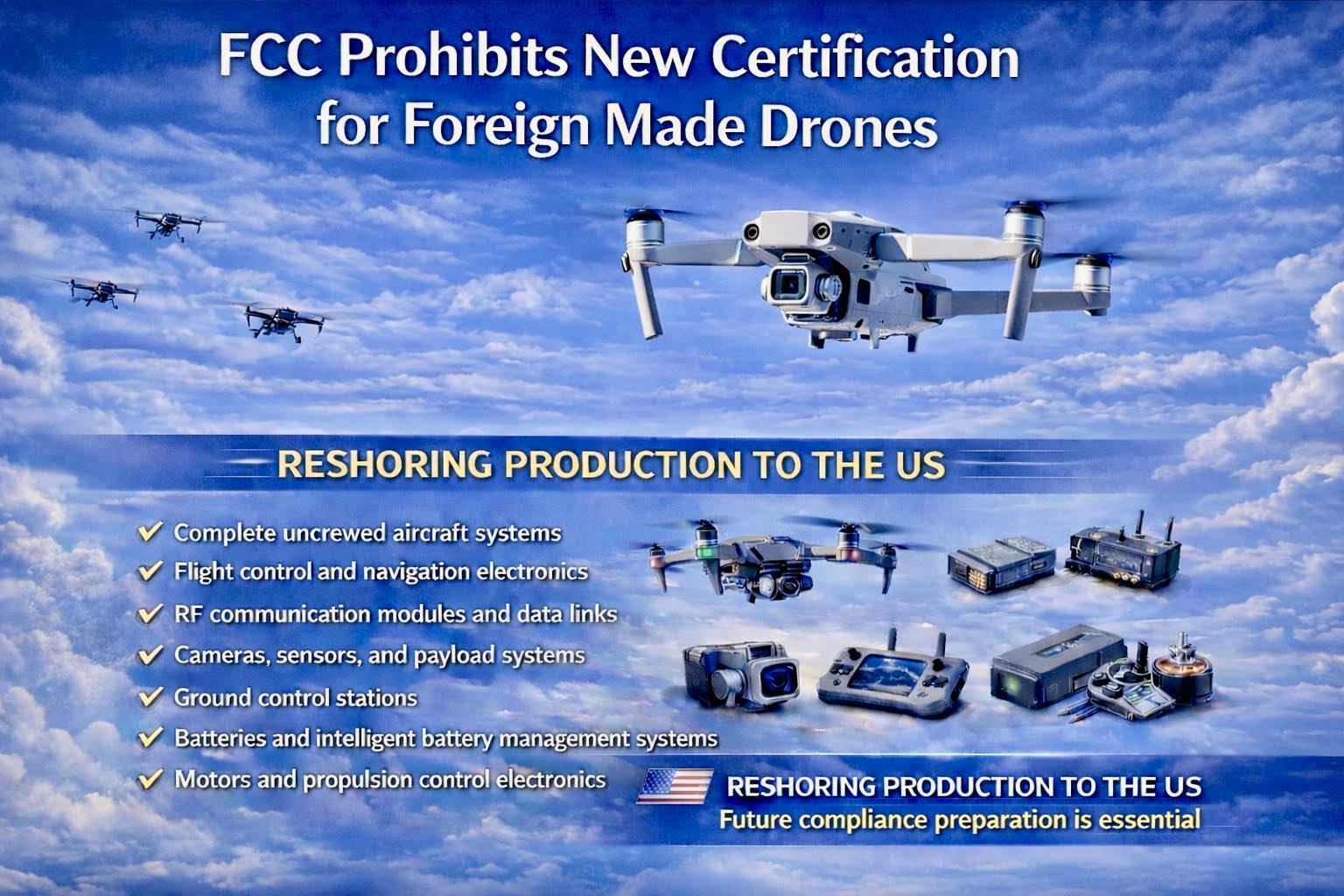
Under DA 25-1086A1, the following categories are now included on the Covered List when produced outside the United States:
- Complete uncrewed aircraft systems
- Flight control and navigation electronics
- RF communication modules and data links
- Cameras, sensors, and payload systems
- Ground control stations
- Batteries and intelligent battery management systems
- Motors and propulsion control electronics
The scope is broad and extends beyond finished drones to many of the components commonly submitted for FCC authorization.
Impact on FCC Equipment Authorization
Manufacturers seeking FCC certification must now ensure that their products are not subject to Covered List restrictions. If a drone or component falls under the Covered List designation, it cannot receive an FCC grant of authorization unless an exemption applies.
This places increased importance on early compliance planning, supply chain transparency, and accurate equipment classification before testing begins.
Products that were previously authorized are not automatically revoked, but future authorizations and new product introductions may be blocked if they involve covered equipment.
What This Means for Drone Manufacturers and Importers
For manufacturers and importers, DA 25-1086A1 introduces new strategic considerations:
- Greater scrutiny of component sourcing
- Potential redesigns to replace covered components
- Increased demand for U.S.-based manufacturing or assembly
- Longer regulatory timelines due to authorization uncertainty
Companies that rely on foreign suppliers for RF modules or navigation systems may face higher compliance risk if those components are considered critical UAS elements.
Implications for Commercial and Public Sector Operators
Organizations deploying drones in industries such as construction, agriculture, utilities, and public safety may experience downstream impacts including:
- Reduced availability of certain drone models
- Delays in replacement parts
- Shifts toward approved or domestically sourced platforms
Procurement teams should verify FCC authorization status and Covered List exposure when evaluating new drone equipment.
Preparing for Compliance Moving Forward
DA 25-1086A1 reinforces a key regulatory lesson: compliance failures often begin long before equipment reaches the test lab.
Manufacturers should take proactive steps including:
- Evaluating whether products or components fall within the UAS Covered List definition
- Engaging compliance experts early in product development
- Reviewing FCC authorization requirements alongside national security policies
- Planning for alternate sourcing or design paths if restrictions apply
Early alignment between engineering, supply chain, and regulatory teams is now essential.
Conclusion
FCC DA 25-1086A1 marks a major shift in how uncrewed aircraft systems are treated under U.S. communications law. By adding foreign-produced drones and critical components to the Covered List, the FCC has elevated national security considerations into the core of UAS regulatory compliance.
For manufacturers, importers, and operators, understanding these changes and adapting early will be critical to maintaining market access and avoiding costly certification delays.